IBM and its distribution partners make co-marketing and market development funds available to partners every year. A meaningful share of that money goes unclaimed, and not because firms don't qualify.
It goes unclaimed because turning it into a campaign takes planning, execution, and documentation, and inside a busy solution provider that work belongs to nobody in particular. So the cycle closes, the funds expire, and the next one starts with the same intentions.
This is not a budget approval problem. There is no CFO to convince and no line item to defend. The money is already allocated for exactly this purpose. It simply requires somebody to do the work.
Every hour a senior person spends on a campaign plan is an hour not on a client project. That trade never wins against a deadline.
If you have one, they're producing content and running the site. Learning a partner portal's claim workflow lands at the bottom of a long list.
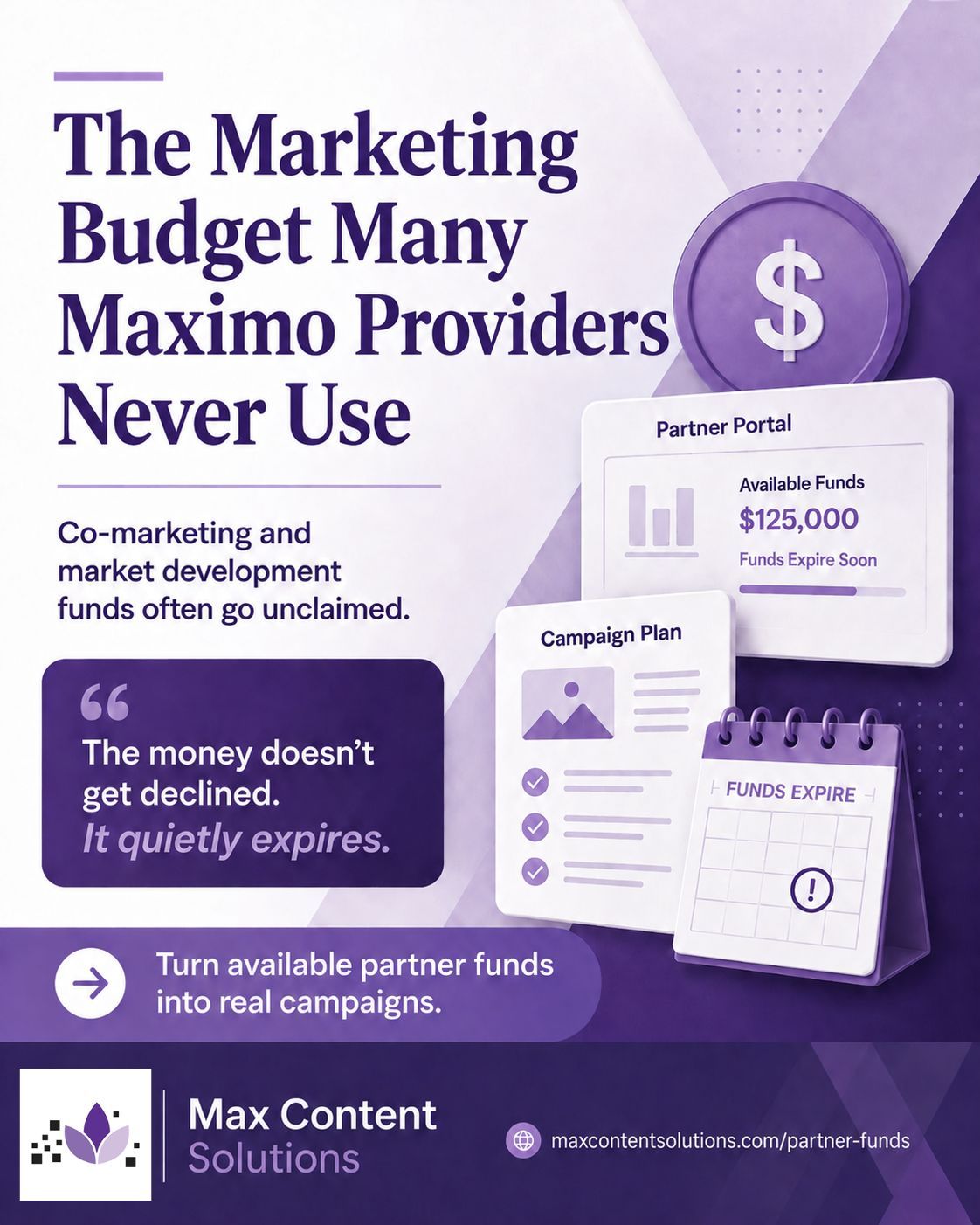
Funding cycles close on dates that live in a portal nobody logs into. The money doesn't get declined. It quietly expires.
Partner-funded campaigns fail in a specific way: a firm builds something purely to satisfy a claim, it reaches nobody, and the exercise gets written off as paperwork. The work below is designed to earn its place in your pipeline first, and satisfy the funding criteria second.
Sessions run with IBM or a distribution partner, from promotion and registration through follow-up sequences and reporting.
Booth assets, pre-show campaigns, demo theater materials, sponsor collateral, and the follow-up that decides whether the booth was worth it.
Multi-channel campaigns aimed at a defined segment, with the landing pages, email sequences, and LinkedIn work to support them.
Articles, guides, and premium assets built for asset managers, plant engineers, and IT directors who evaluate providers for a living.
Case studies and reference material produced to a standard that survives a procurement review, not a testimonial page.
Paid and organic programs targeted at the narrow audience that actually buys EAM software, rather than a broad industrial spray.
What qualifies varies by program, by partner tier, and by funding cycle. Confirming what your firm is eligible for in the current cycle is the first thing we do, before anything gets scoped or built.
Four stages. The last one is where most attempts fall over, and it's handled end to end.
A review of what co-marketing and market development funding your firm may have available through IBM and your distribution relationships, plus the current cycle's requirements and deadlines.
A campaign built to do two things at once: reach Maximo buyers in a way that's genuinely worth doing, and satisfy the qualifying criteria attached to the funds.
Every asset the campaign needs, produced to the same standard as any content engagement. Landing pages, email sequences, LinkedIn campaigns, webinar promotion, event materials.
Claim paperwork, proof of execution, and performance reporting assembled and submitted against the cycle deadline rather than after it.
Thirty years in Maximo means knowing what a campaign aimed at asset managers and plant engineers has to sound like to be credible. A generalist agency can assemble the paperwork. It cannot write something a plant engineer will read past the third sentence.
Multi-year IBM Champion status means knowing how this ecosystem's programs are structured and where partners consistently get stuck.
More usefully than either: we've built partner-funded campaigns and worked claims through to resolution recently enough to know what the current process actually requires, rather than what a two-year-old document says it requires.
Both are quoted directly once we know what's available and what the campaign needs to accomplish. No rate card, and no long sales process attached to finding out.
Fund identification, campaign design, full asset production, and claim documentation for one funding cycle. The right starting point if you've never claimed before, or want to see the process run once before committing further.
Every available cycle tracked and claimed rather than catching one and missing three. For partners holding several relationships with different criteria and deadlines, where the calendar itself is most of the problem.
On how this gets paid for. In many cases the campaign production itself is a qualifying expense under the fund, which changes the question from what this costs to what it unlocks. Whether that applies to your situation depends on your specific program terms, and it's part of what the first conversation covers.
If funds are available, you run a campaign on money you weren't spending. If they aren't, you've spent twenty minutes finding out and you know what to ask for next cycle.
Expertise In. Pipeline Out.